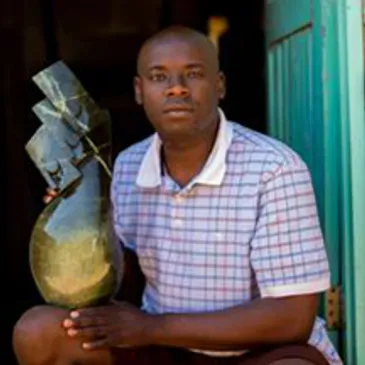
Bronson Gengezha
There is a hidden spirit inside the stone that can be drawn out. Sometimes just by looking at the stone it can tell a story and guide your hand.
Bronson Gengezha was born in 1981 in Harare, Zimbabwe. He attended Ellis Robins Boys’ High School, where he excelled in every subject but took a special interest in history.
Bronson credits his father, Temba Gengezha, as his greatest inspiration. From 1975 until his untimely death in 2001, Temba’s sculptures were immensely popular, celebrated locally and abroad for their style and artistry. As a child, Bronson played with stones on the floor of his father’s workshop, but it wasn’t until 1998, at the age of 17, that he began to sculpt and hone his artistic vision under his father’s tutelage. His creativity shows in the skill, originality and attention to detail of his work. He looks up to sculptors like Chituwa Jemali and Dominic Benhura for their unique styles.
Bronson’s pieces can be found in galleries and private collections in Germany, Canada, Australia, Holland, Japan, South Africa and, most recently, the United States.
He travels to the Kwekwe mines, two hours outside Harare, to select raw stones for his home workshop. He prefers colourful stones such as Kwekwe serpentine, fruit serpentine, verdite and opal stone. Like most sculpting stone, they are mined without automated tools, and transformed using handmade tools such as the traditional mbezo, rasps and handmade chisels and files. No electric tools are used in the creative process.
Common themes in his work include mother and child, looking to the future, introspection and lovers. Speaking about his relationship with stone, Bronson says: “There is a hidden spirit inside the stone that can be drawn out. Sometimes just by looking at the stone it can tell a story and guide your hand.”